
How Daft Punk Created End of Line from Tron: Legacy

Tron: Legacy is the 2010 sequel to the original 1982 Tron, which had a score by Wendy Carlos. Daft Punk took over scoring duties for Legacy, blending orchestral elements with their usual synth-driven electronic style. A third film, Tron: Ares, came out in 2025, scored by Nine Inch Nails, who skipped the orchestra entirely and went full electronic.
End of Line plays during Sam’s first visit to the End of Line club, where Daft Punk appear as the club’s resident DJs. The song opens with a drone sitting over a typical Daft Punk four-to-the-floor beat, before two different bass riffs come in one after the other. Here’s my full End of Line remake:
Daft Drone
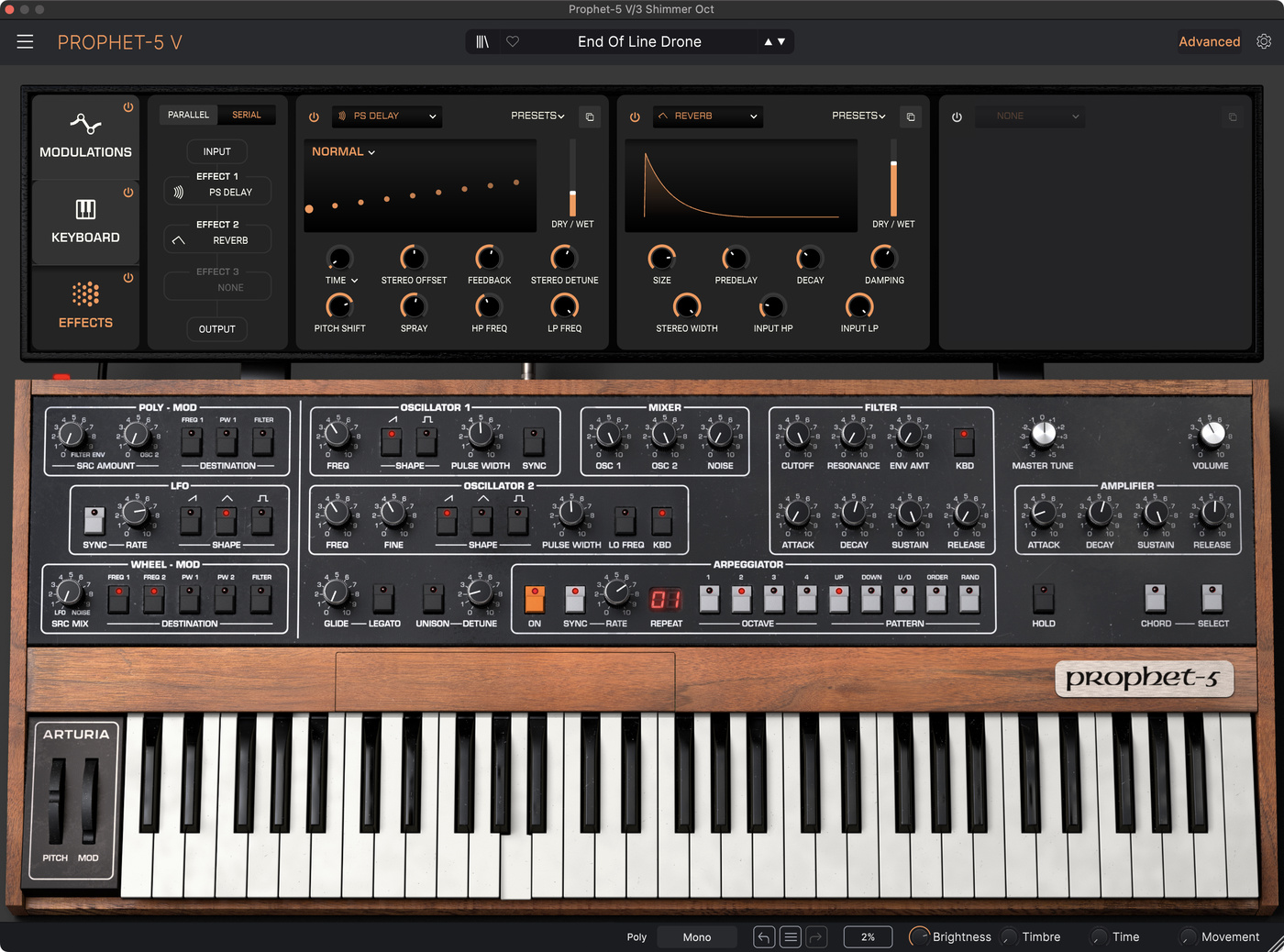
End of Line is built over a drone that plays throughout the entire song, and I recreated it using two layers. For the main layer, I used Arturia Prophet-5 V set to arpeggiator mode, so it jumps up and down an octave on 16th notes, giving you a bouncing octave of A. There’s also some shimmery high-end which I recreated using a pitch-shifting delay and a big reverb.
Shimmer effects are typically created by shifting delayed repeats up an octave before feeding them back into the delay. Each repeat becomes brighter than the last, creating that characteristic sparkling high end. Prophet-5 includes a pitch-shifting delay that can produce a similar effect. I set it to shift up 12 semitones with the low-pass filter fully open and the feedback at around 56%, which lets the octave-up repeats build into that bright, shimmering texture.
After the pitch-shifting delay, I added a big reverb using the Hall preset as a starting point. Below you can compare the dry Prophet-5 arp to the fully processed version. I also layered in a low brass sample to add some low-end.
- Dry Synth00:00
- Pitchshift + Reverb00:00
- Brass Layered00:00
End of Line Drums
The drums play from the very start of the song, and being Daft Punk, the kick is doing most of the work. To recreate it, I used a Vengeance kick sample as the base, but the original has a tonal, almost 808-like character that I couldn’t find in a single sample, so I layered in Ableton’s Analog, set to a heavily filtered square wave with the pitch manually tuned to match the kick from the original track.
- Drums00:00

First Riff
After the intro, the first riff comes in: a bassline that moves through A, D, F, played with a syncopated pattern using dotted 16th notes. That syncopation is what creates motion against the four-to-the-floor kick. Even though there aren’t any actual chords being played, the bassline outlines an Am | Dm F progression. That’s a style favored by artists like Depeche Mode, Nine Inch Nails, and Grimes, and it’s part of the electronic direction Daft Punk gravitated toward on Tron: Legacy.
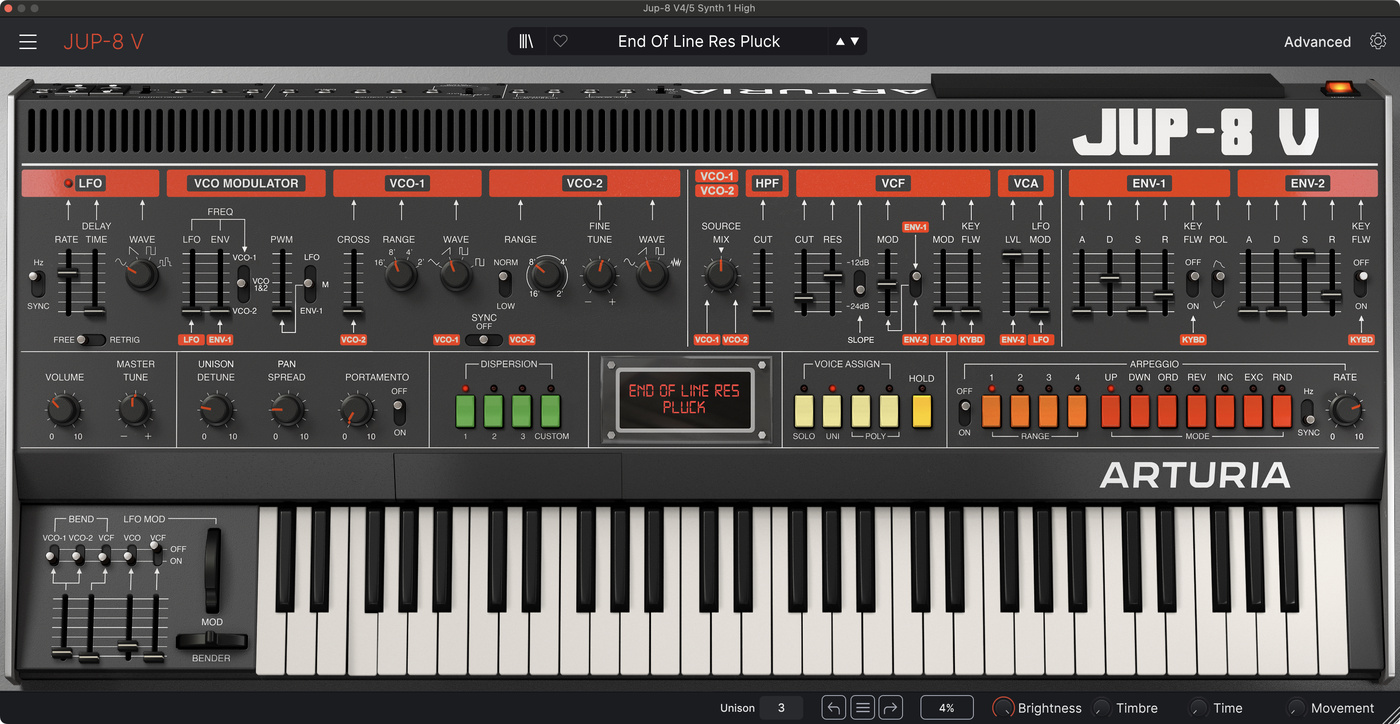
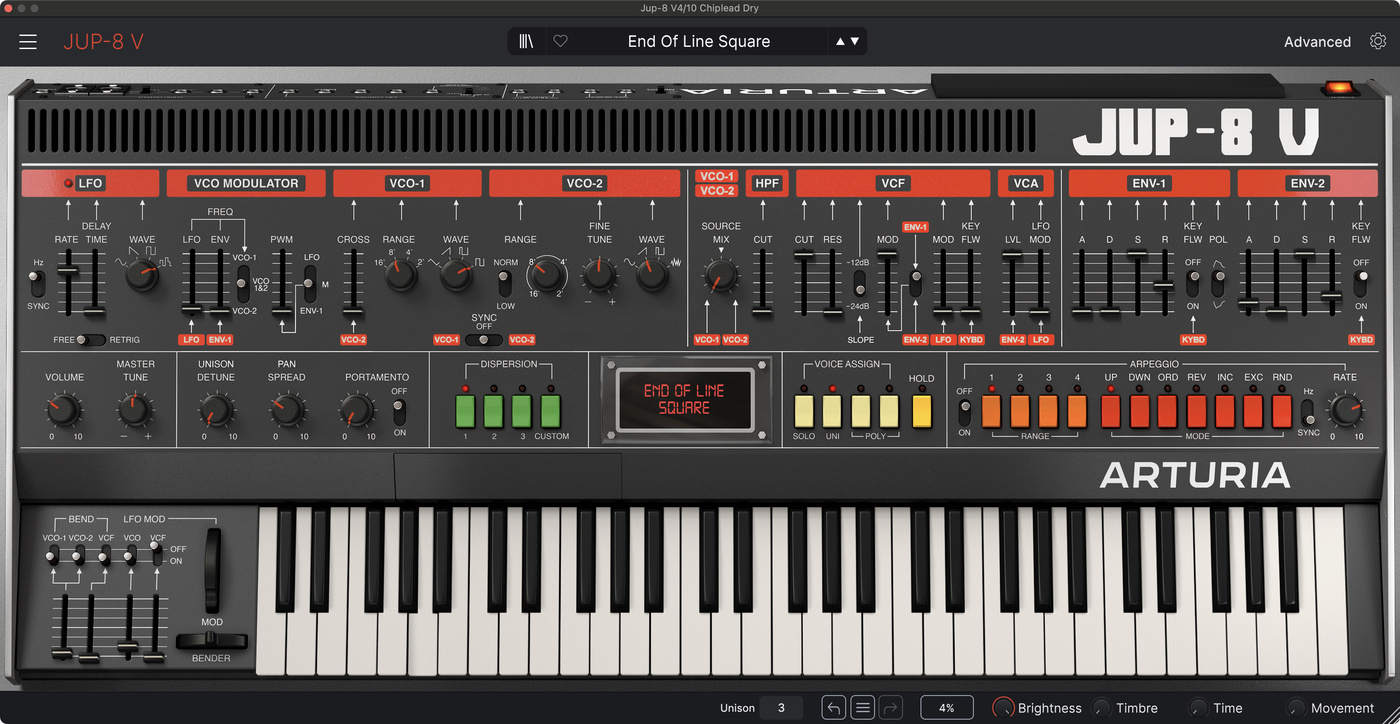
I used two layers for the riff; in the first, I used Arturia Jupiter-8 V4 set up as a resonant pluck. Resonance is around 0.6, filter cutoff at around 100 Hz, with only a small amount of envelope modulation and a four-second decay. That combination keeps it resonant but muted, since the filter never opens up into the high end.
It’s also running in unison mode, but to stop it from sounding too thick, I dropped unison voices down to 3 and set pan spread to a modest 0.2 for a little stereo width.
Underneath that pluck sits a basic low layer of sawtooth waves with the unison detune set to its minimum value.
- Riff 100:00
Second Riff
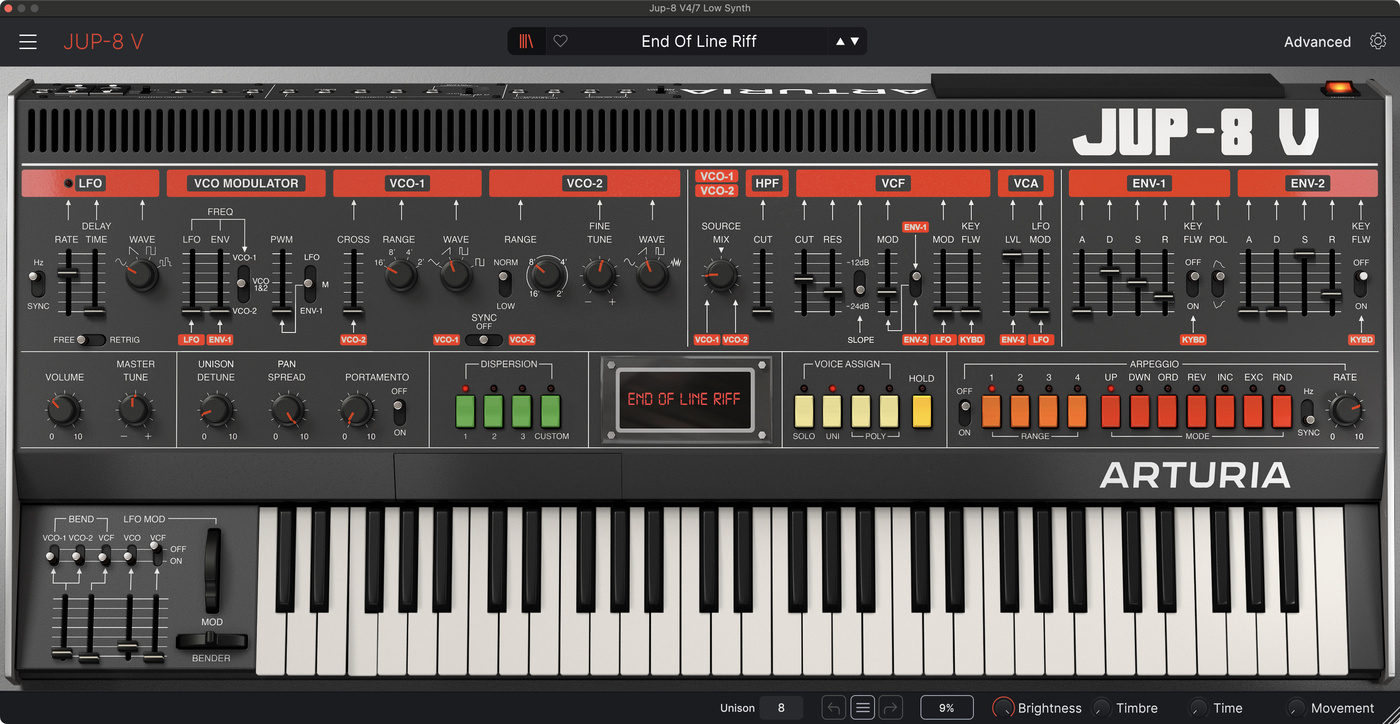
The first riff plays for eight bars, then the main riff comes in and carries most of the rest of End of Line. It still follows the same Am | Dm F movement, but instead of just outlining the bass notes, it plays a more melodic phrase. There’s not a ton of variation once it’s in, because it’s written to support a scene rather than constantly demand the listener’s attention.
For my remake of this riff I used Arturia Jupiter-8 V4 again, this time with unison voices set to 8 for a thicker, more modern texture, pan spread pushed to 1 for full stereo width, and unison detune at 0.07. The detuned sawtooth waves are split an octave apart, with source mix set to 80% favoring the lower octave. Resonance is medium, and the decay is a long 9.79 seconds, letting notes ring out rather than cutting off.
- Riff 200:00
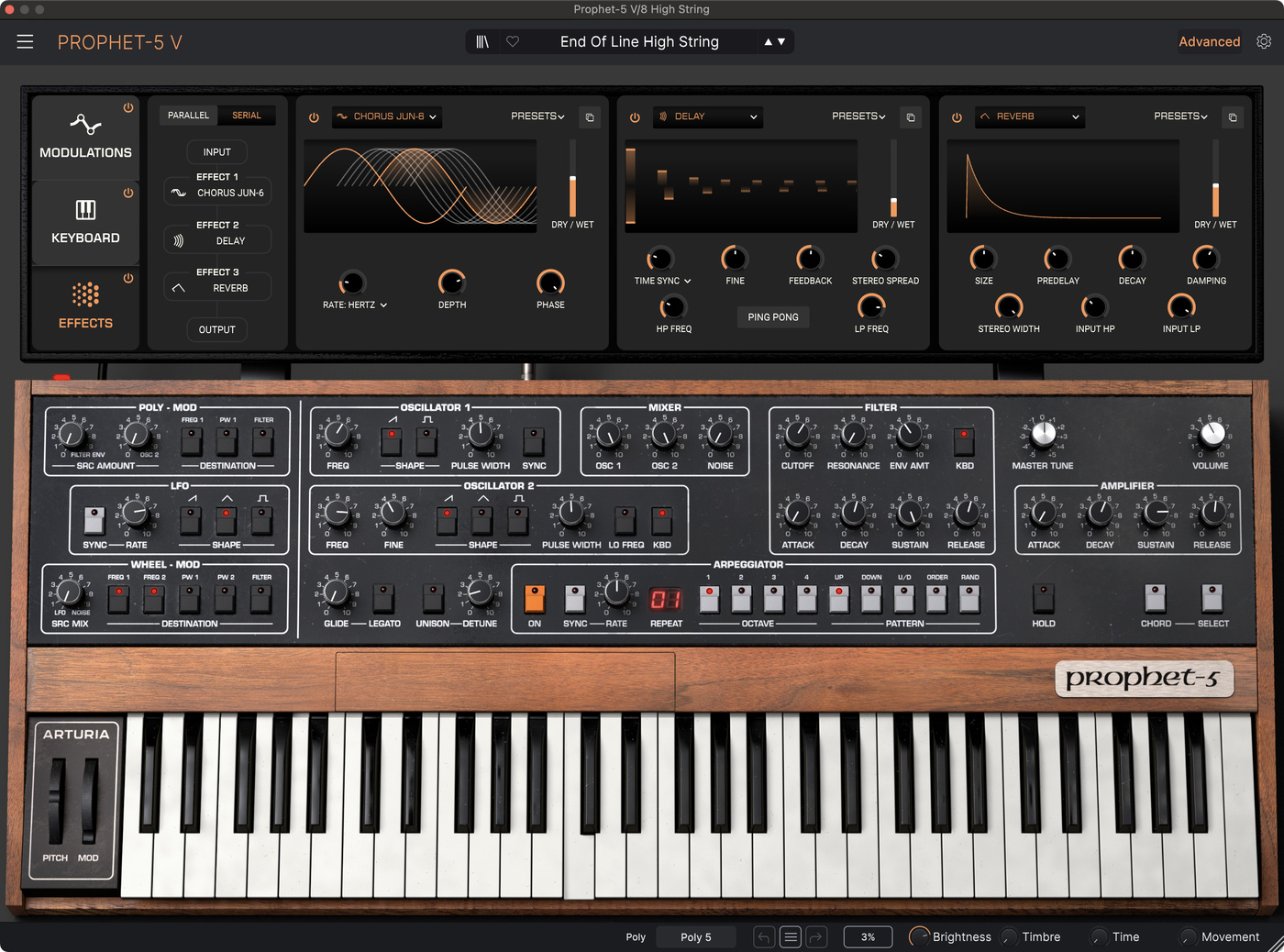
Higher up, there’s a string layer played an octave above the main riff, built from two Prophet-5 sawtooth waves an octave apart, run through the Prophet-5’s Juno-6 chorus for that classic chorused string sound. That’s layered with a second Prophet-5 patch an octave lower, roughly the same patch but with different filter settings.
- String00:00
Chiptune Lead
One of the sounds that plays the second riff is a glitchy, 8-bit style lead. The chiptune glitch effects are pretty chaotic, so rather than try to recreate it note-for-note, I tried to capture the main idea behind the effect using only Ableton’s built-in effects.
The synth patch itself is very simple: a square wave from Arturia Jup-8 V4 with the filter fully open. Like some of the earlier patches, I used three unison voices with just a small amount of detune and pan spread to give it a little stereo width.
- Square Lead00:00
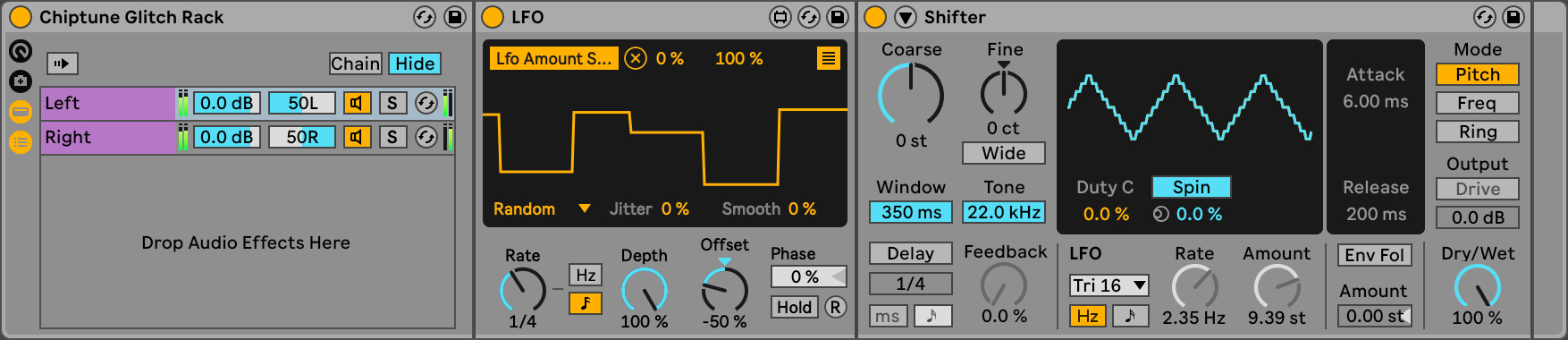
For the glitchy digital effect, I used Ableton’s Shifter in Pitch mode. Its onboard LFO is set to the Triangle 16 waveform, which creates that familiar chiptune-style pitch modulation. Rather than leaving it static, I used a Max for Live LFO device in Random mode to continuously modulate Shifter’s own LFO rate and amount. This means the pitch modulation is always changing rather than repeating in a predictable pattern.
To make the effect fully stereo, I duplicated the Shifter inside an Audio Effect Rack and panned one instance hard left and the other hard right. Each side has its own independent random modulation, so the left and right channels are always behaving slightly differently.
- Shifter00:00
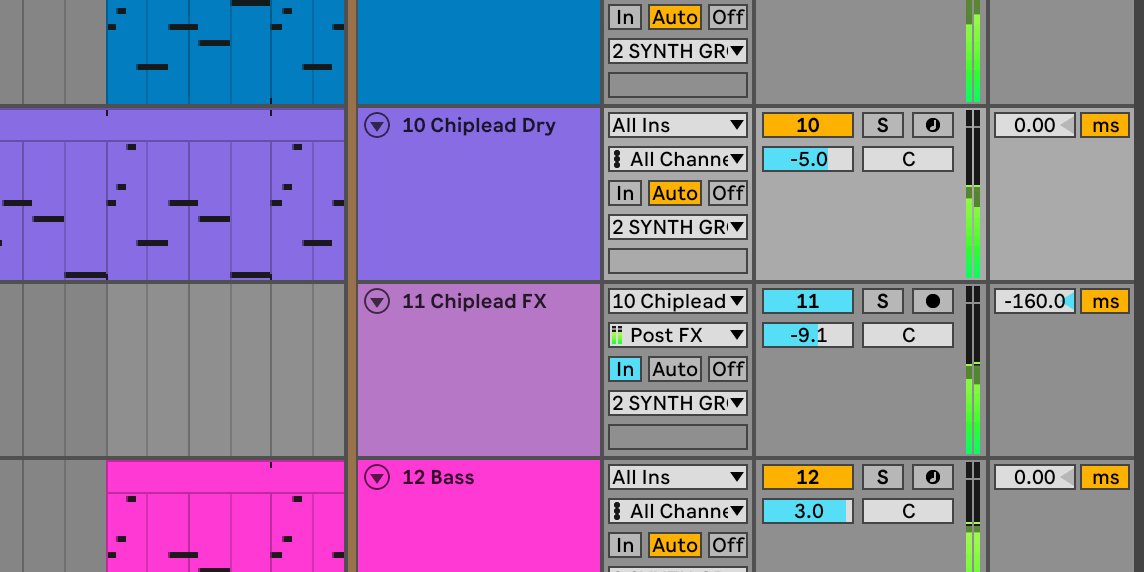
Shifter’s large pitch-shifting window introduces a noticeable delay, so to avoid timing issues, I put the Audio Effect Rack on a separate audio track and used Ableton’s Track Delay set to -160 ms. In Live, using a negative Track Delay causes every other track to be delayed by the same amount, bringing everything back into sync.
Free Presets
 Thanks for reading! If you would like to see more Tron: Legacy remakes, let me know which tracks you want me to cover in the comments below!
Download Presets
Thanks for reading! If you would like to see more Tron: Legacy remakes, let me know which tracks you want me to cover in the comments below!
Download Presets
Plugins Used
The following plugins were used in this article. Some links are affiliate links, which help support Reverb Machine.
Remake Project

Explore the complete Ableton Live remake project, including all synth layers and mixing effects inside Ableton Live.
Requires Ableton Live 11+ and third-party plugins. All tracks are frozen, so you can still explore the projects even if you are missing plugins. See below for the full plugin list.
Get the full Ableton Live project for this remake, including stems and MIDI plus access to a full year of remake projects on Patreon.
Get the Project
Thank u !. This tutorial is very good . we hop u do TRON Legacy (End Titles) (From “TRON: Legacy”/Score) acid House and score
Great choice! I think they used a 303 on that one.
Thank you. This tutorial is amazingly good and insightful. I hope you get around to recreating the lead synth in The Grid.
Love that sound. Definitely planning on doing “The Grid” but the orchestral elements make it a bit more challenging.