

Wham!’s Last Christmas is one of the most enduring Christmas songs ever written. Although it didn’t reach number one on release in 1984, the song has seen a huge resurgence in recent years, finally reaching number one on New Year’s Day 2021, then becoming the UK Christmas number one in both 2023 and 2024. In doing so, it became the first song to hold the Christmas number one spot for two consecutive years.
Last Christmas was written, performed, and produced entirely by George Michael, who wrote the song in February 1984 and recorded it later that year in August. The track was reportedly recorded using only a LinnDrum, Roland Juno-60 and sleigh bells, although there is clearly a bass guitar on the recording as well. All the synth parts came from the Juno-60, and the same chord progression repeats throughout the entire song.
In this article, I’ll break down the Roland Juno sounds used in Last Christmas and show how they can be recreated today. Firstly, here’s my full remake:
The main string sounds in Last Christmas come from the Roland Juno-60, a relatively low-cost synth released in 1982. There are several synth tracks that all play the same chord progression. As the song develops, more layers are introduced, gradually thickening the arrangement.
I think that the main string parts were recorded using the 13 Strings 3 factory preset as a starting point, rather than using Manual mode. This preset combines the pulsewidth modulation and sawtooth oscillators with the Chorus II effect for a very sweet sound.
To get the Last Christmas sound, start by turning off the Sub Oscillator. Tighten up the sound by lowering the release fader, and add some brightness by raising the VCF Envelope fader.
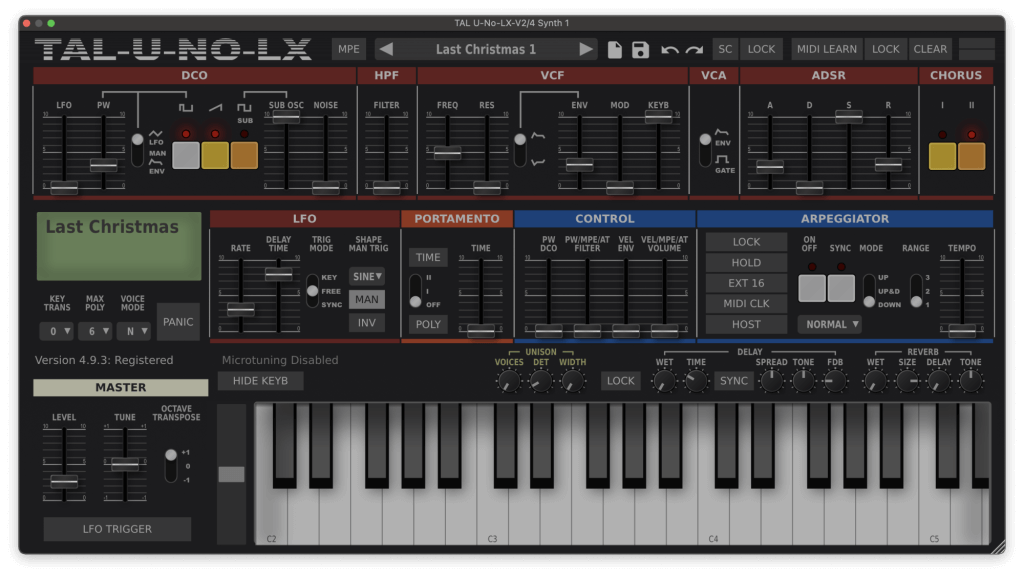
A second synth track is introduced after eight bars, panned to the left. For my remake, I used the same patch, switching to the Chorus I effect and tweaking the envelope by lowering the attack and slightly raising the release.
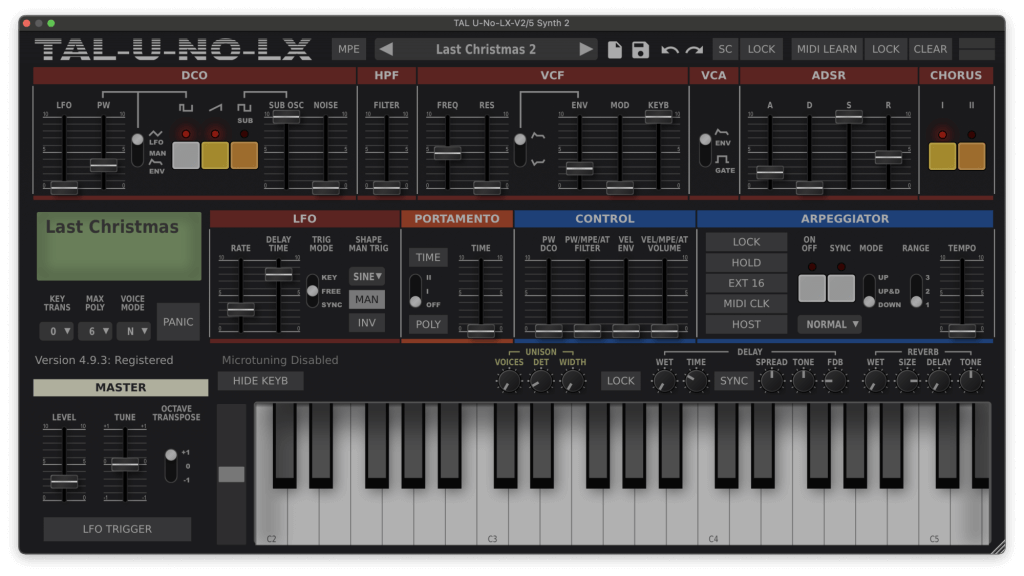
At around the 1:10 mark, the two main strings drop out, revealing a third string layer. This sound is more muted and sits further back in the mix.
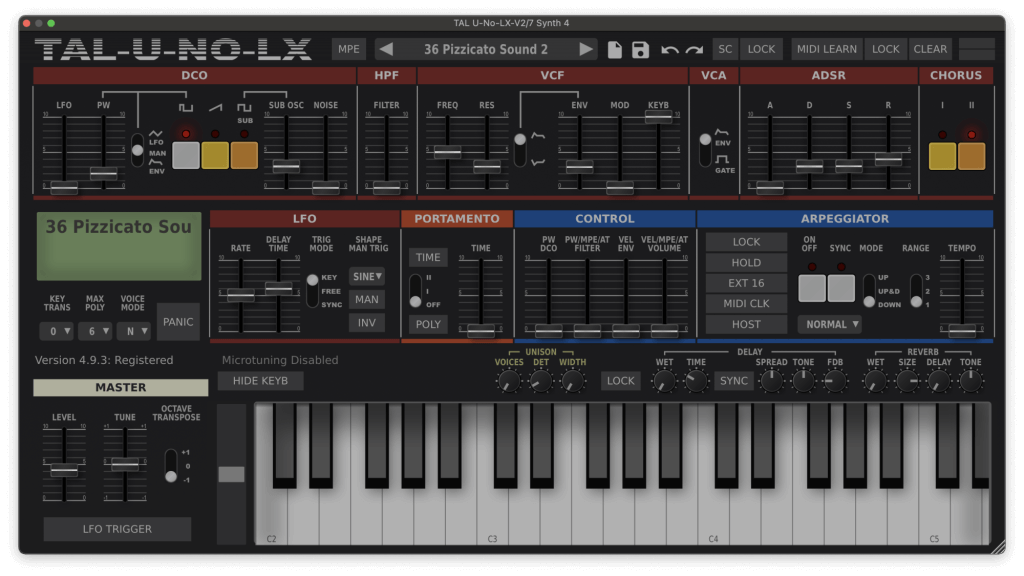
Finally, during the last chorus, at around the three minute mark, a fourth and much brighter synth layer is introduced, again playing the same chords. I think the Juno-60 preset 36 Pizzicato Sound 2 was used for this track, with no edits required,
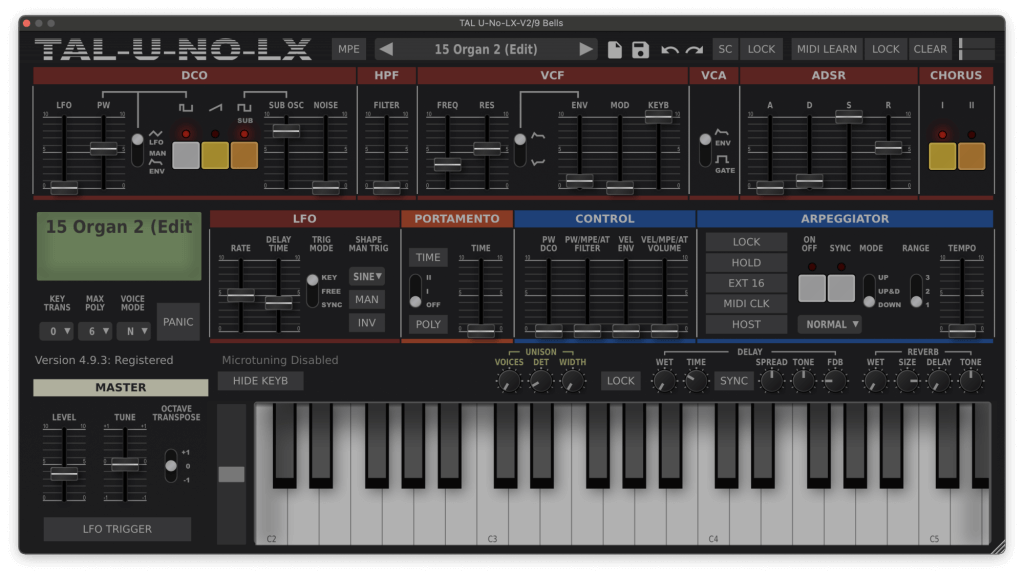
After the chorus, there’s a festive-sounding melodic hook. This part sounds like the Juno-60 preset 15 Organ 2. In the factory patch, releasing the key stops the sound immediately, whereas in Last Christmas, the notes fade out gradually.
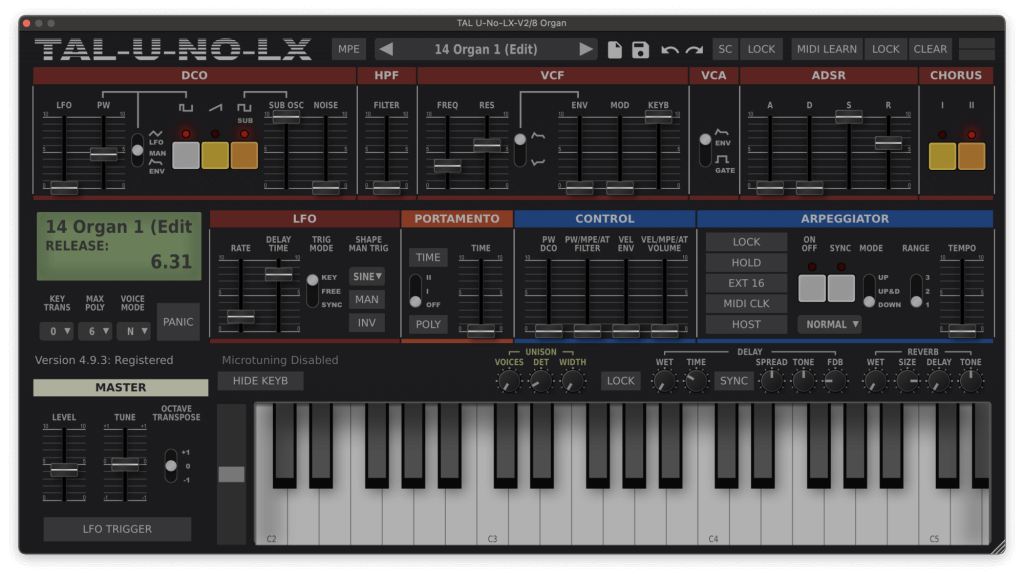
Edit the patch by changing the VCA mode from Gate to Envelope. The sustain can then be raised to maximum and the release set around halfway. You also need to lower the VCF ENV fader, since the envelope now has full sustain. For this patch, I set it to 1.
There’s also a subtle organ track that plays before the melody. I used Juno-60 preset 14 Organ 1, as the basis for this sound, again setting the VCA to Envelope mode, adjusting the ADSR envelope, and setting the VCF ENV amount to 0. I also switched the Chorus effect from I to II for a wider, more detuned sound.
The bass guitar is a simple but important part of the arrangement, and it was most likely played by George Michael himself. There is no credited session bassist, and the part is very straightforward, mostly outlining root notes with some melodic leading notes.
For my remake, I recorded the bass straight into my audio interface and kept the processing minimal, using only Ableton Live’s Saturator, EQ Eight, and Compressor to shape the tone.
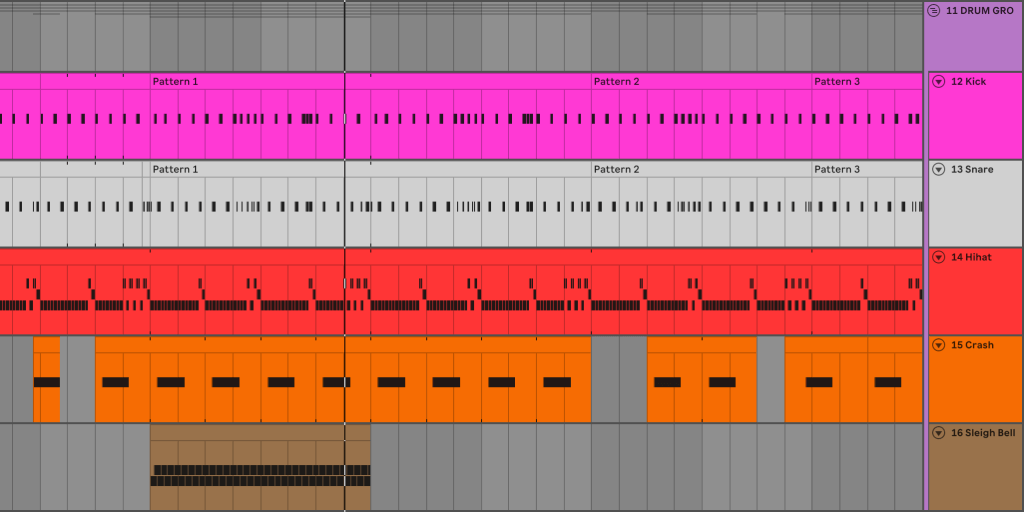
A LinnDrum was used for the drums in Last Christmas. In my remake I used LinnDrum samples for the kick, snare, and hi-hats. The drum pattern programming is also more detailed than it first appears. Rather than looping a single pattern, the song uses many variations with small changes in drum fills. Programming this on a LinnDrum would have taken time, as patterns are created and chained manually.


You can have a look at the Netflix Doku of Last Christmas. Chris Porter is flipping through the stems. For me the stem is called DX7 bells. And especially the lower notes get a better attack. Maybe they have overdubbed it later and it is actually both!
Great, I believe this is the best recreation I have seen in the net so far. Thanks a lot for the effort.
To my knowledge just add the DX7 Vibes and it will be perfect. You can clearly hear them in the lower register where this little metallic shine comes through (along with the harder attack from the higher velocity).
It 100% does not sound like a DX7 to my ears. The Vibes patches are too percussive and thin to match the melody sound in “Last Christmas”, in my opinion.