

Brian Eno released Discreet Music in 1975; the majority of the album is taken up by its 30-minute title track, which was one of Eno’s first experiments in the quiet, unobtrusive music that would go on to define his career, as well as ambient music. The idea for the piece came from Eno “discovering” a new way of listening to music, where at low volumes the sound sits on the verge of vanishing and merges with the background noises of the environment.
In this article, I’ll explore how Eno created Discreet Music using a simple but clever tape loop system built around early synth sequencing and sound-on-sound recording. For my remake, I used two software plugins: Arturia Synthi V, an emulation of the EMS Synthi AKS used by Eno on Discreet Music, and Soundtoys EchoBoy for the tape delay effects.
Discreet Music Synthesizer
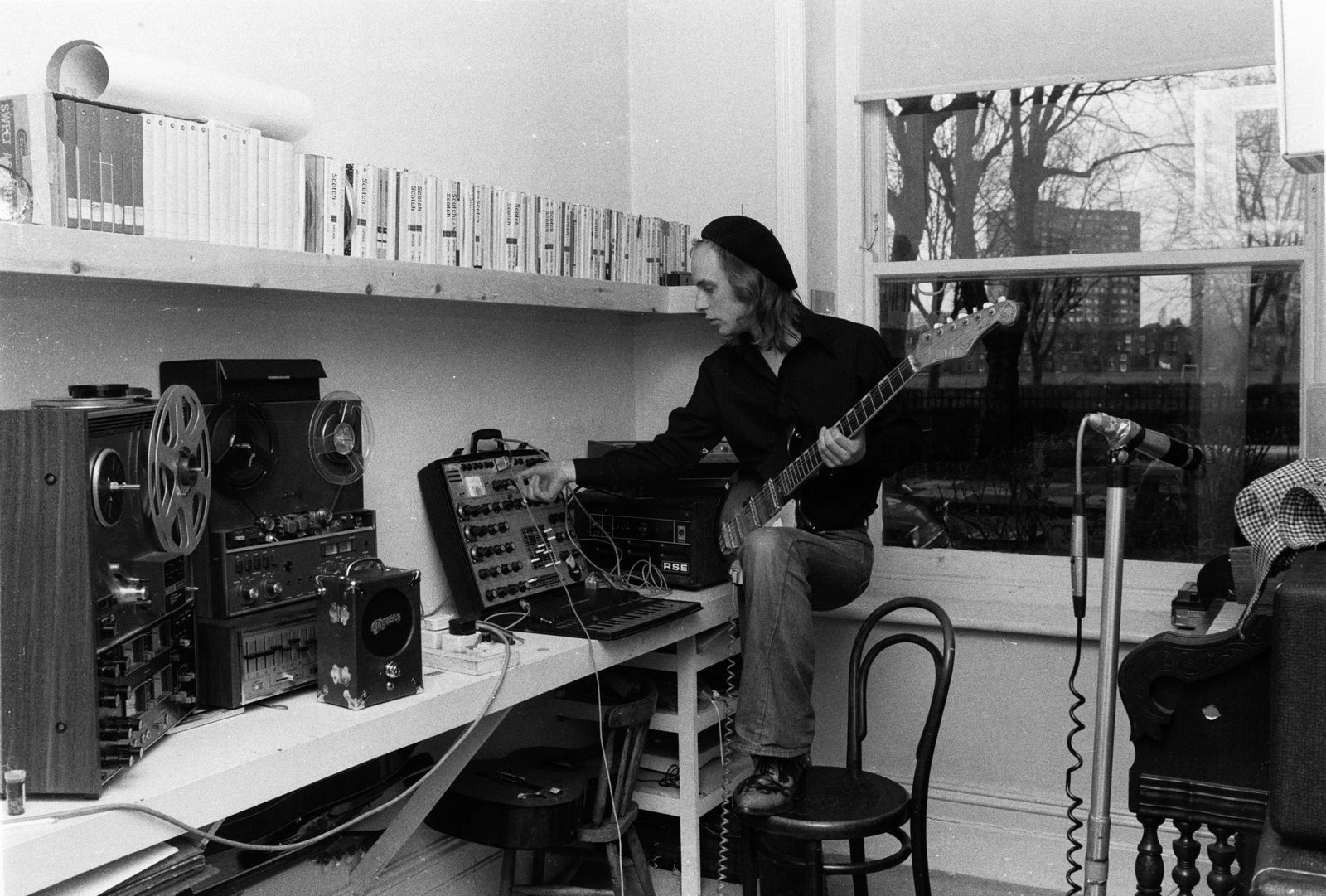
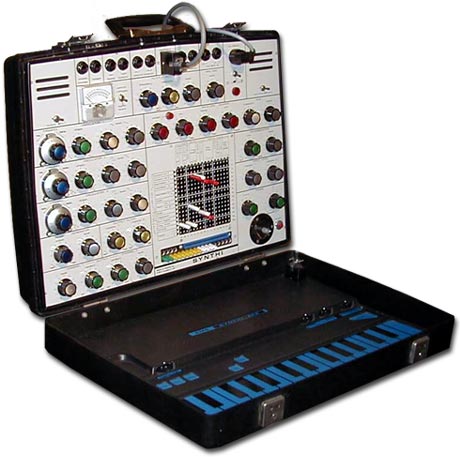
Eno recorded Discreet Music using an EMS Synthi AKS, a portable analog monosynth released in 1972 with modular and sequencing capabilities. Eno was an early adopter of EMS synthesizers, using the EMS VCS3 during his time with Roxy Music in the early 1970s. By the mid-’70s he was also using the portable EMS Synthi AKS, which remained one of his main instruments throughout the decade. Eno later used the Synthi on David Bowie’s Heroes in 1977 to process Robert Fripp’s guitar.
The EMS synths had several unique features, including an early digital sequencer and a matrix-based patching system. While many modular synths of the 1970s used large form factors and patch cables for routing, the Synthi used a patch matrix where pins are placed to create connections. Different coloured pins could be used to control the amount of attenuation and modulation. This design made the synth compact but surprisingly flexible. Other interesting features are the joystick for hands-on parameter control and the built-in spring reverb.
The Synthi was also famously used in On The Run by Pink Floyd, where the digital sequence creates the fast repeating pattern.
Arturia Synthi V
Synthis are hard to come by now, and when they do, they fetch mega prices (think £20,000+). Arturia recently released a software version called Synthi V, which recreates the original instrument with some modern additions, and unlike the hardware, doesn’t cost five figures. The Discreet Music patch is relatively simple to set up, and makes use of oscillator blending and the onboard reverb. Here’s how to set it up:
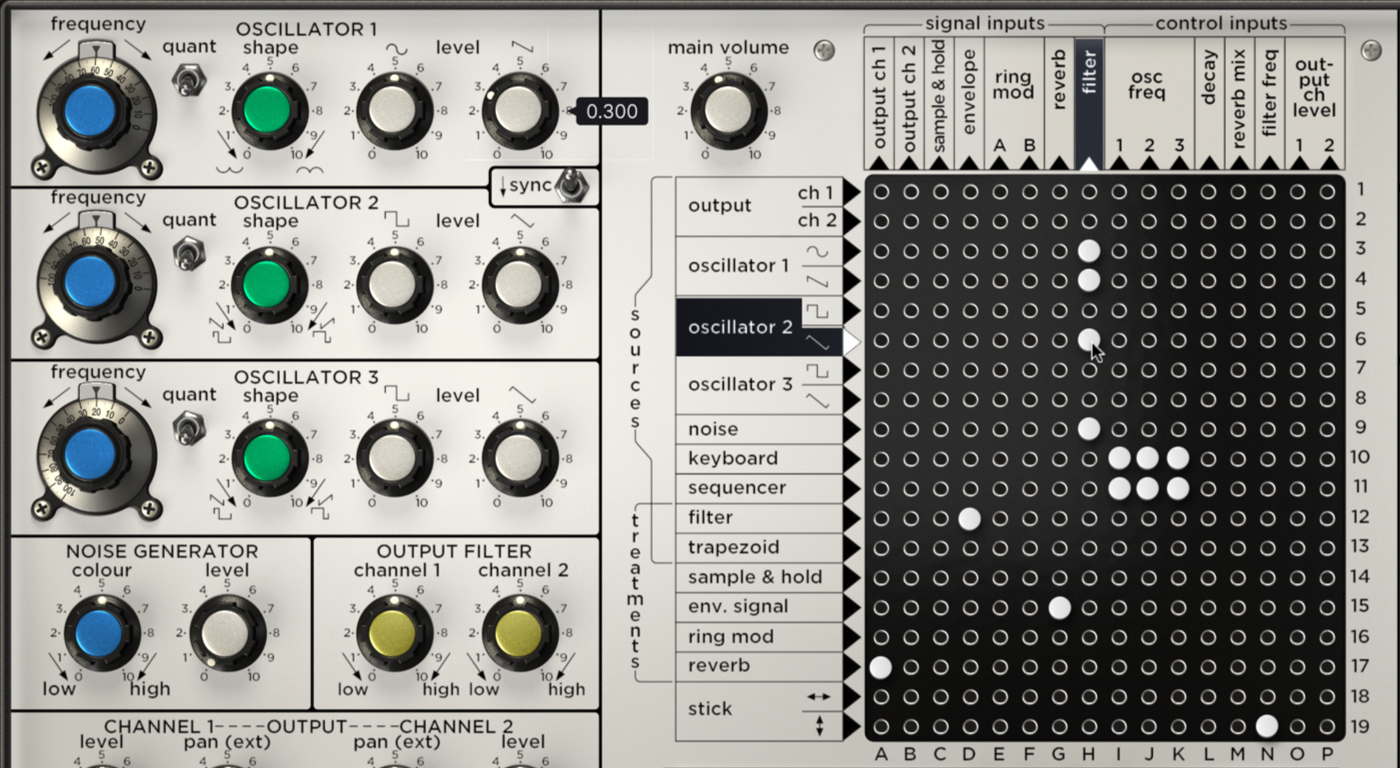
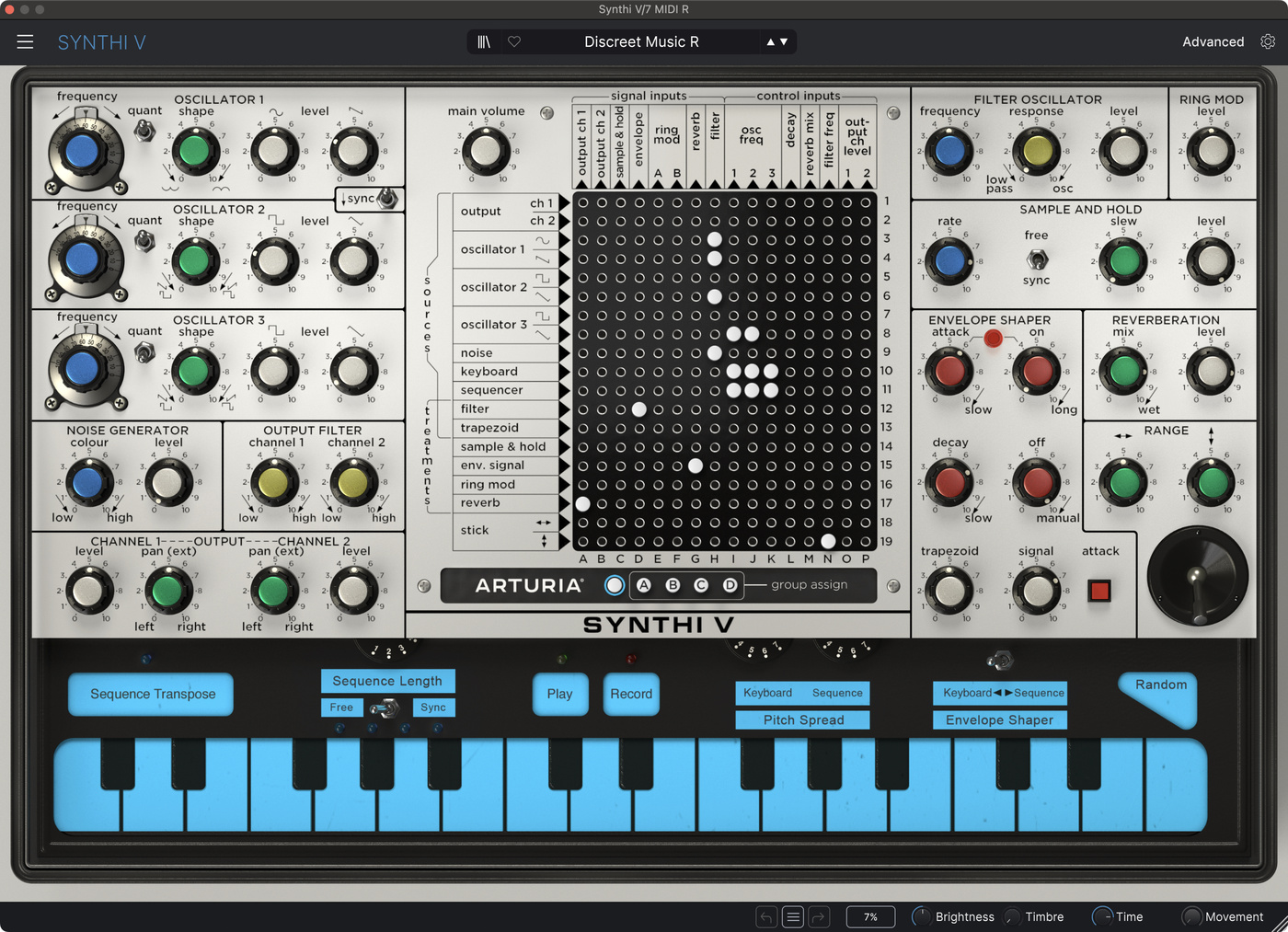
Start by initialising Synthi V: choose New Preset… from the menu. The oscillator sound is a mellow sine/triangle wave made slightly brighter by mixing in some sawtooth oscillator. On the Synthi, each oscillator produces two different waveforms, and in the init preset oscillator 1’s sawtooth wave is already connected. Connect oscillator 1’s sine wave and oscillator 2’s triangle wave by placing pins at matrix points 3H and 6H, which connect the oscillator sources on the left to the filter input along the top row. Then, balance the sawtooth volume by lowering oscillator 1’s saw knob to around 3.
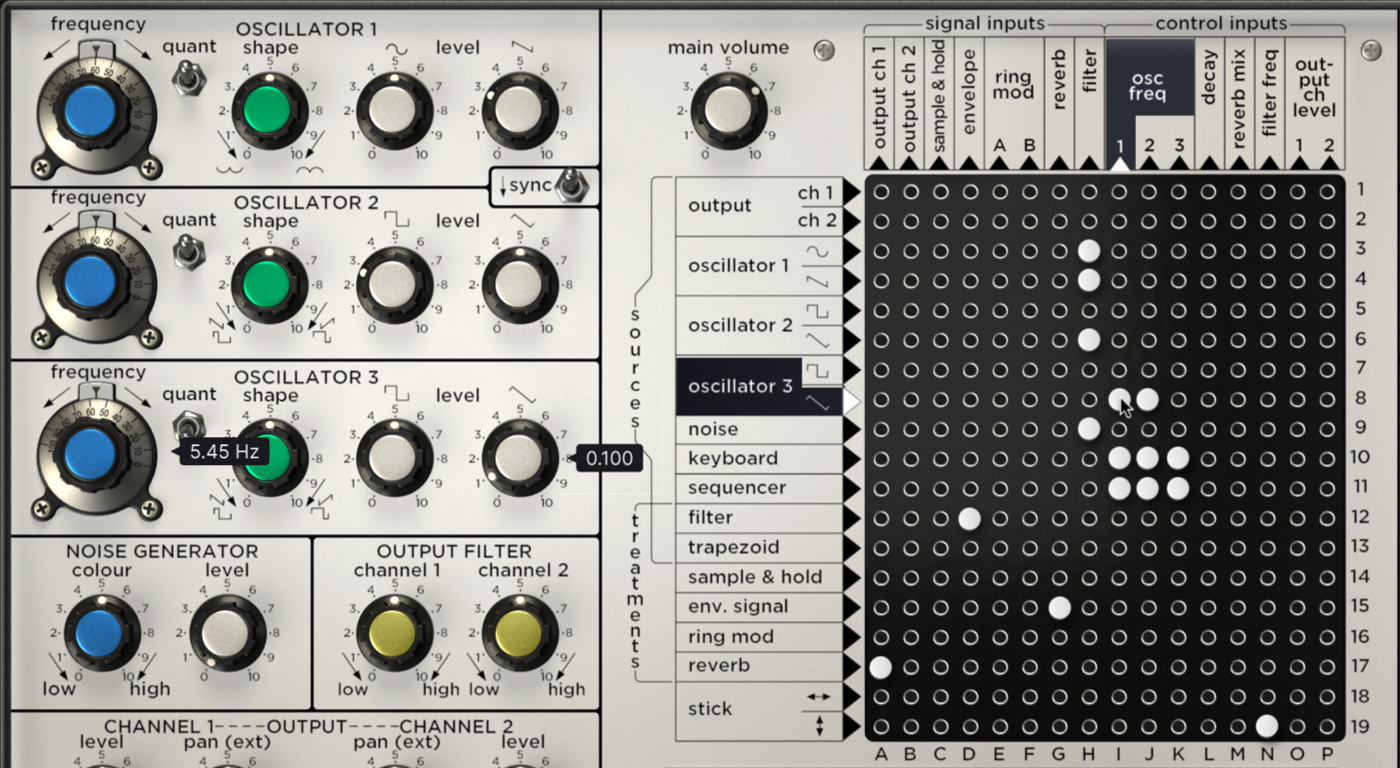
I also added some subtle vibrato by patching oscillator 3’s triangle to the control inputs for oscillators 1 and 2 (I8 and J8), setting oscillator 3’s frequency nice and low, and the triangle’s level low to control the amount of vibrato. The cool thing about setting up vibrato this way is that the modulation tracks the keyboard, so higher notes get a slightly faster vibrato while lower notes get a slower one.
Darken the sound by lowering the filter cutoff, the blue frequency knob at the top left, to just below halfway (0.472). Soften the beginning and end of the sound by raising the attack and decay knobs to the right of the patch grid to 6 and 7, respectively. This results in gentle fade-in and fade-out when you play a note. Eno also likely used some of the Synthi’s built-in reverb, so raise the reverberation mix knob to 9.
- Discreet Music Synthi Dry00:00
Discreet Sequencing
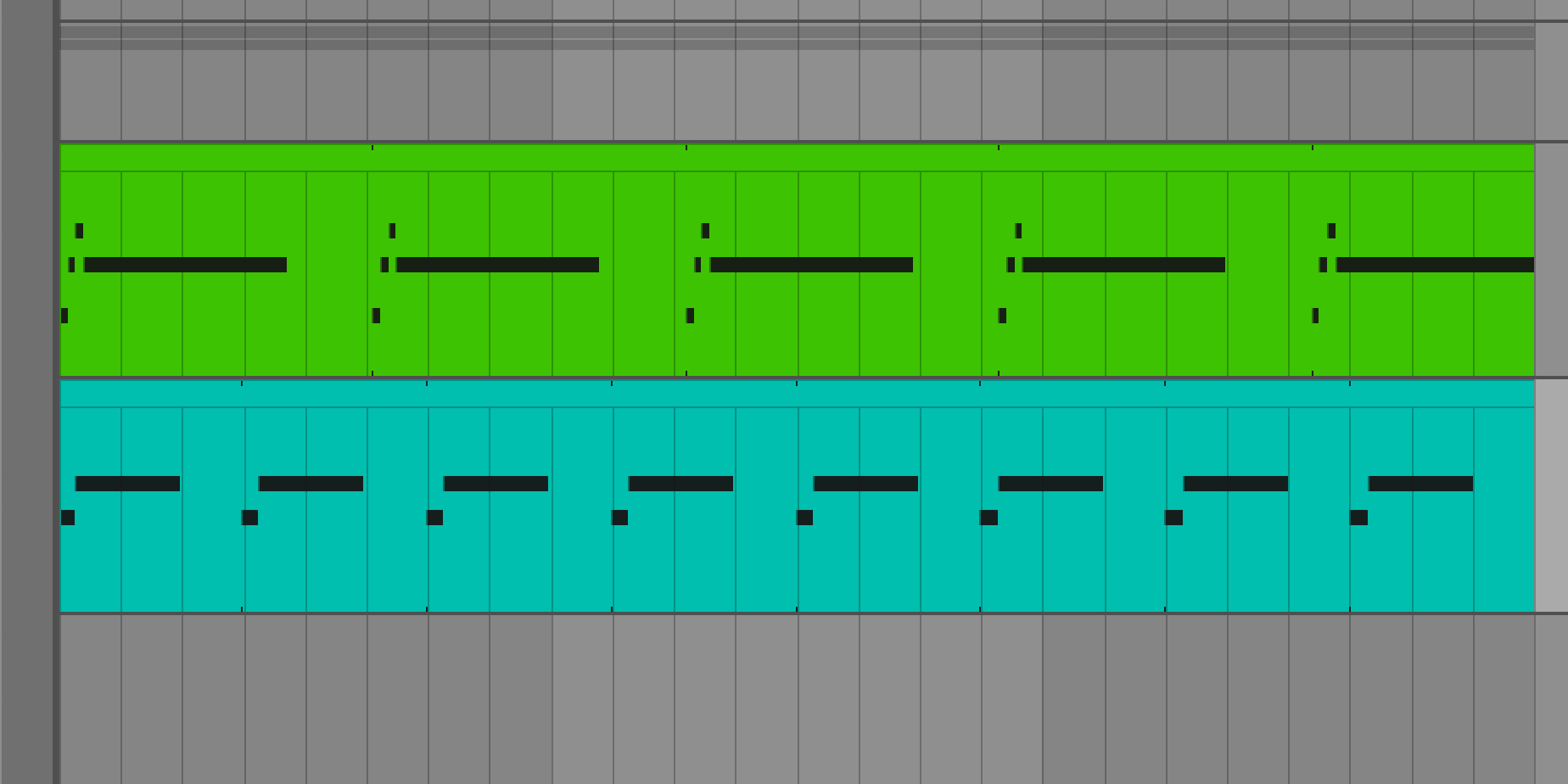
One of the most interesting aspects of Discreet Music is that it’s built from two independently running sequences. The sequences are panned left and right, and loop at slightly different lengths: around 63 seconds for the left sequence and about 69 seconds for the right sequence on the final released recording.
Because the two sequences are different lengths, they gradually drift out of sync with each other. After each repeat, the right sequence begins slightly later relative to the left sequence, which means the two loops constantly form new combinations as they overlap in different ways. Eventually, after around 15 minutes of playback, the two sequences return close to their original alignment and the cycle begins again.
The Synthi’s onboard sequencer is one of the earliest digital sequencers, powerful for the time but unusual by today’s standards. You record a sequence by pressing the record button and playing in notes manually. However, rather than using a traditional step-sequencer, the sequence length knob controls the playback speed of the sequence.
Longer sequence lengths result in slower playback, while shorter lengths make the sequence play faster. To create Discreet Music, Eno would have set the sequence length very high and manually played in the melodies. For my remake, I programmed the notes in Ableton’s MIDI piano roll using two separate tracks, each containing an instance of the Synthi patch.
Below you can listen to the two sequences without the tape looping system. Discreet Music is in the key of A♭ major, and the right sequence clearly outlines the root triad (A♭ C E♭) while also adding a colourful sixth above it.
- 00:00

The left sequence introduces a small amount of tension by using the fourth (D♭), which creates dissonance if it plays at the same time as the third, a semitone away (C). It also ends with a great four-note melodic motif that you’ll instantly recognize. Also, notice the amount of silence! This prevents things from getting too busy when the tape-looping is added, which I’ll cover next…
- 00:00

Discreet Tape Loops
In a 2015 interview with Barbican, Brian Eno outlined the effects chain on Discreet Music: a graphic equaliser, a Gibson Echoplex and two Revox tape recorders. The graphic equaliser allowed Eno to manipulate the tone of the Synthi, and the Echoplex is a classic delay effect.
The most interesting part of the setup is the two tape recorders, which were part of a system that Eno developed with Robert Fripp called Frippertronics. Indeed, Discreet Music was originally intended to be used as a backing for Robert Fripp’s guitar playing, and a short edit appears on their 1975 album Evening Star under the name Wind on Wind.
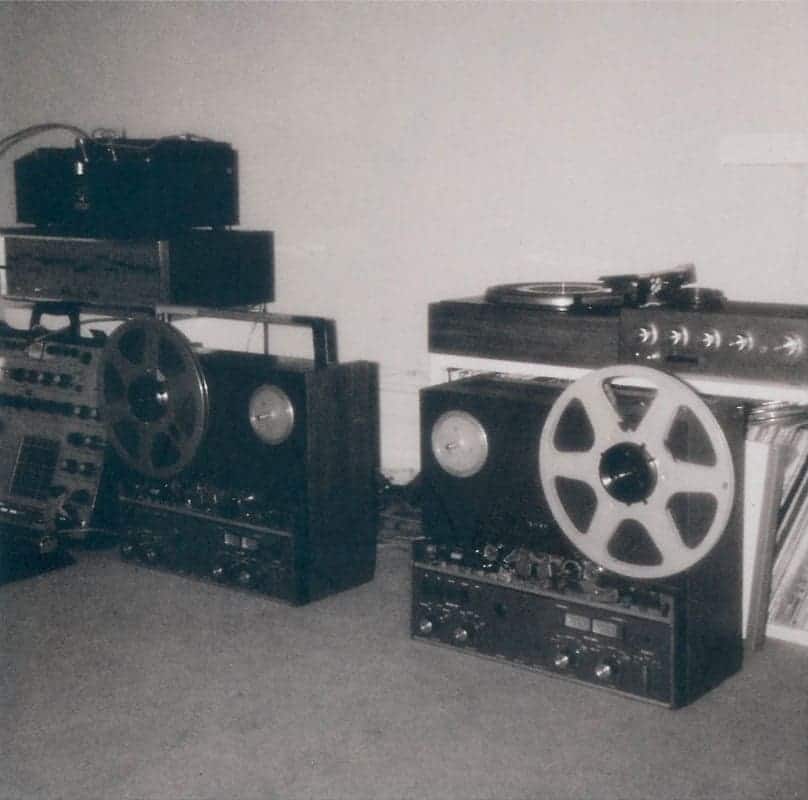
Although the setup of two tape recorders might seem complicated, it was really just a practical way of creating looping delays before digital samplers and loop pedals existed. One tape recorder would play back the sound while simultaneously recording it onto the second tape machine. The second machine would then feed the sound back into the first, creating repeating loops.
By adjusting the feedback level, Eno could control how many times the loop repeated before gradually fading away. Because the system was tape-based, the repeats also slowly lost clarity and high-end over time, giving the loops their soft, hazy quality.
Soundtoys EchoBoy
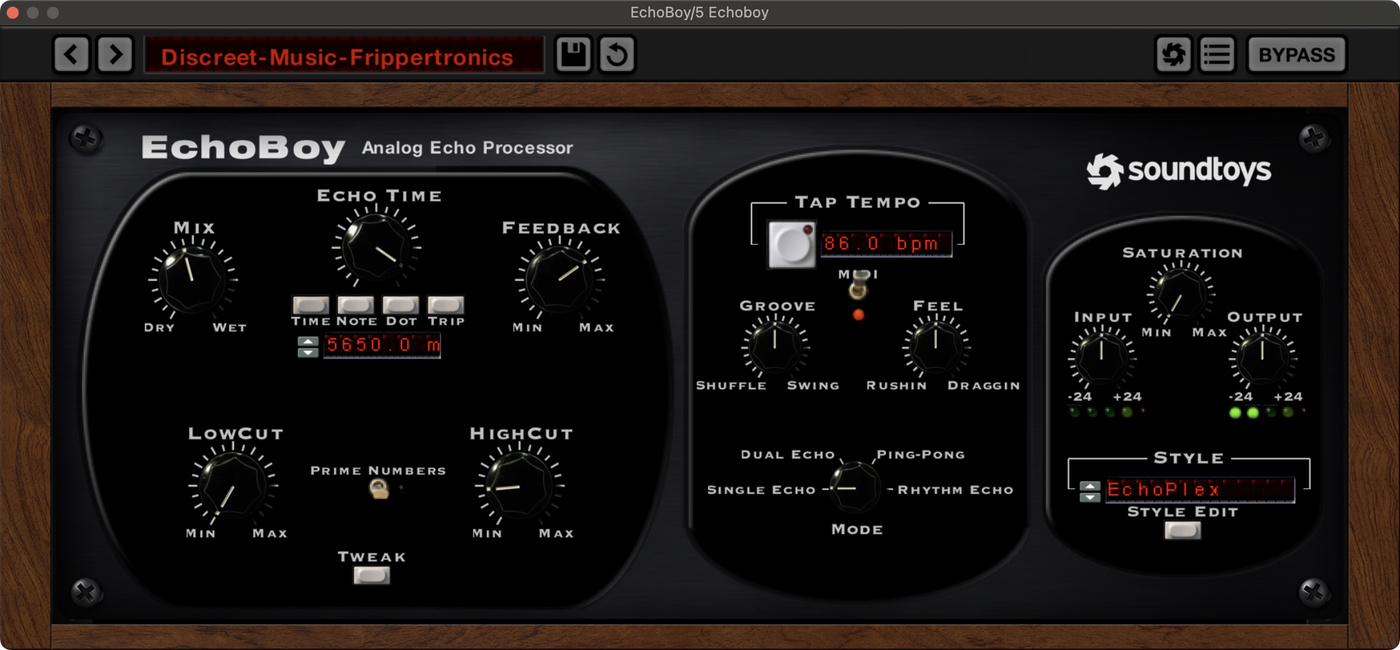
For my remake, I used Soundtoys EchoBoy to recreate the Frippertronics looping system. The delay time is set to 5650ms, with the mix just below 50% and the feedback set high so the repeats gradually fade out over time. Most delay plugins don’t allow delay times this long, but EchoBoy handles it easily.
Once this is set up, each phrase repeats around five seconds later, causing the sequences to overlap and form constantly shifting combinations.
I also used EchoBoy to emulate the sound of Eno’s Maestro Echoplex tape delay. For this, I used EchoBoy’s Echoplex style with a shorter 160ms delay time, high feedback, and a mix level of 40% to add extra ambience and tape-style character.
- Discreet Music Frippertronics00:00
Discreet Remake
Below you can watch my remake of Discreet Music. I used two MIDI sequences in Ableton Live, each triggering a separate instance of Arturia Synthi V. Both synth tracks are processed individually with Soundtoys EchoBoy using an Echoplex-style delay setting to recreate the original tape echo.
The two synth tracks are then grouped together in an Ableton Group Track and sent through the EchoBoy Frippertronics-style setting, followed by a light compressor to help glue everything together.

Manipulating Time
In a 1979 interview with Melody Maker, Eno revealed that Discreet Music was slowed down by half after the recording process. This means that the sequence and delay times I mentioned are actually double the values that he would have worked with: the sequences would have been 31–34 seconds long, and the Frippertronics delay time would have been roughly 2.8 seconds rather than 5.6 seconds.
The slowdown would likely have been a practical necessity, as the Synthi AKS’s onboard digital sequencer was only capable of sequencing phrases roughly 34 seconds long. However, in a 2016 interview with Interview Magazine, Eno also claimed that the final half-speed playback was discovered accidentally. Eno said: “I put that one on by accident at half speed and it sounded very, very good.”
Slowing tape down by half also lowers the pitch by an octave, meaning that Discreet Music was originally recorded an octave higher than the version we hear on the album.
Below is an approximation of how Discreet Music may have sounded before the tape slowdown process. The oscillators are tuned an octave higher, the Frippertronics delay time is reduced to 2825ms, and the filters are opened slightly to reflect the brighter original recording.

Further Reading
Here are links to the interviews mentioned throughout the article:
Additionally, Eno continued developing these looping techniques throughout the 1970s. By the time he released Ambient 1: Music for Airports in 1979, pieces like 1/2 and 2/1 used up to eight independently running tape loops to create much denser and more complex combinations. You can read more about that process in my article on deconstructing Music for Airports.


btw, seems like i found what graphic EQ Eno used, a Soundcraftsmen 20-12. i found a comment on an Instagram post about the making of Discreet Music that said that they also own that “Sound Craftsman” EQ. further googling found me the right model, a 10-band EQ; the bottom matches up!
Yes, that looks like the one
I have been experimenting with generative audio since I was 15 ish. Using two tape recorders a length of tape between them a simple Casio keyboard and a self build ring/FM modulator.
But besides that. Now that there are no longer time restrictions on audio distribution and SoundCloud tracks can last literally for hours I wonder what Eno would’ve done if that was available then. Anyway: fantastic work deconstructing Sir Eno’s work
when doing it at double speed, i found that eno didn’t use the synthi’s reverb, plus the echoplex seems to have a really short delay because there’s not much slurring between one note and the next, but your examples were a great foundation to build out of! cheers
btw for the echoplex i substituted echoboy with audiority’s plexitape vst which is modeled after and an accurate emulation of an echoplex
Interesting observations, glad the examples were helpful!
Fascinating! Thank you. These explorations and recreations of Eno classics are really helpful.
Glad you think so! This kind of system-based music is very satisfying to try and pick apart.
This is a very cool and informative article. It shed some light on a few questions i had. Wish more people took time to analyse these sorts of musical mysteries
So, there’s one thing you didn’t address in this article— Eno only had one Synthi. I guess we must assume the two 30 second sequences were recorded separately and then mixed together. But what I’m wondering is, were they recorded dry on two tracks and then treated with Echoplex and Time Lag together? Or were they each recorded wet with Echoplex and Time Lag, and then the two “wet” recordings mixed together? Or some combination of recording and processing and then mixing (and processing)?
I think recorded wet with Echoplex and Time Lag and then mixed together. It’s the easiest way of doing it (the mix is stereo but the Echoplex only takes mono ins and outs) and the most creative, as he’d be able to monitor and hear the Time Lag effect in real time.
Thanks for this fine article and the midi downloads.
Are there wet versions of the two Synthi sequences available somewhere?
Amazing and exact replication. You’ve got all the bases covered. Something so complex, so evocative, created with simple loops and delays and tape.
I was struck by the shelf in the photograph of Brian Eno. Are they textbooks, or tape boxes? That’s a lot of tape boxes.
reel-to-reel tape boxes, I imagine he went through a fair amount of tape
Great to put a light on the mysterious piece ! would be also interesting to focus on « thursday afternoon », thanks for all of this !
Great. Thanks a lot.
And another wonderful insight into the systems of Ambient music. Thanks alot for your work – again it’s very inspiring for me to start experimenting with this knowledge. Had a lot of fun in my studio with it yesterday. I am getting more and more into generative music. Thanks to you! Next I want to integrate my hardware synths more and make use of the tape function from my OP-1.
Very cool! Makes me want to get my hands on that Arturia Synthi too.
For the more programming-oriented, I did the same reconstructions of Discreet Music and Airports 2/1 a few years ago: https://teropa.info/blog/2016/07/28/javascript-systems-music.html
Hi Tero! Yeah, the Synthi V plugin is a little unusual compared to modern synths, but it’s still pretty charming, and the modulation system is fun for experimenting. I actually came across your article in my research for this, my Javascript knowledge is pretty limited but it’s a well written article and was enjoyable to follow!
Brilliant decoding and recreation. This is a great Window into the power of limitations. Love it. Thank you !
excellent and clear review, love Eno and have often wanted an in-depth analysis of this simple yet powerful composition
Thanks Paul! Yes, I’ve always been curious about the exact sequences too, turns out it’s simpler than it sounds!
excellent review !