

When In My Room was released in 2019, it was Frank Ocean’s first new music in over two years, following his 2016 albums Blonde and Endless. The track has a minimal, stark aesthetic, with Ocean handling production alongside Michael Uzowuru, who also co-produced Nights from Blonde. The drum programming was handled by producer Sango.
This is actually an updated version of a remake I originally published back in 2020 as part of my Frank Ocean Synth Sounds Part 2 article. That version used the older Prophet V3 plugin, which is no longer available, so I’ve recreated everything using newer plugins. Here’s my remake:
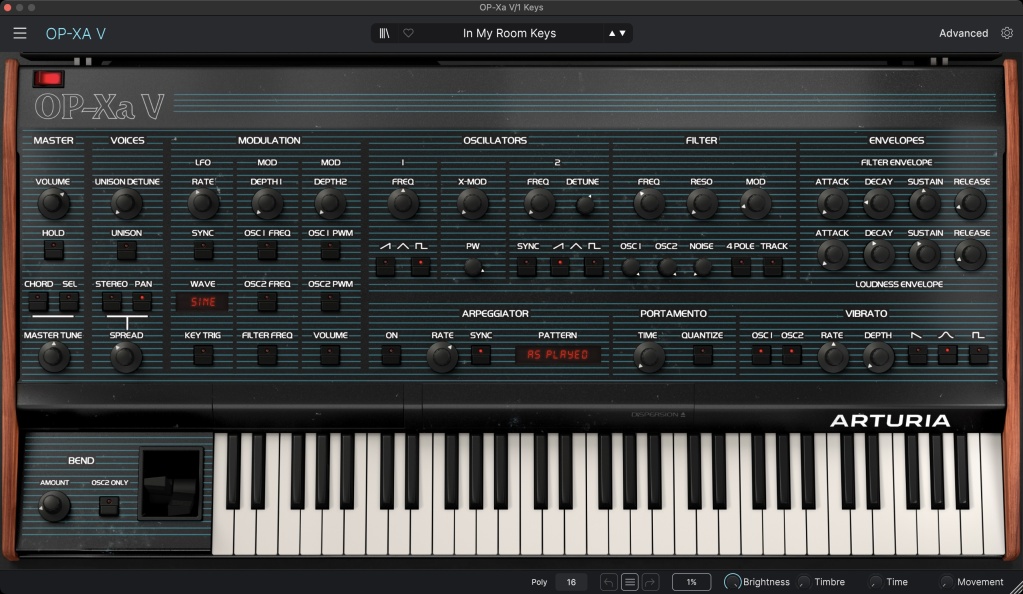
The main synth part plays single note keys that outline the chords Gmaj7 | F♯m7. There are a few variations that are played in a 12-bar pattern that loops throughout the song. I used Arturia OP-Xa V to recreate the main synth, as it has a pan spread function which can be heard in the original song.
The most important settings for this sound are a thin pulse wave and wide detune between two oscillators. I set oscillator 1 to a square wave and left oscillator 2 on the default sawtooth wave. Set the PW knob to 86.5% to make oscillator 1’s square wave a thin pulse wave. Oscillator 2’s detune is set to 0.200 semitones, which is 20 cents sharp. Whereas about 11 cents is a good amount of fat detune, this creates a more phasey, unstable sound.
The filter cutoff is set to 116 Hz with a small amount of envelope modulation, using OP-Xa V’s default 2-pole filter slope rather than the more common 4-pole found in most synths. For the envelopes, I used a short decay with about 50% sustain for both the filter envelope and the amp envelope. The filter envelope decay is set to 270 milliseconds which creates a fast, snappy pluck.
The In My Room synth has a small amount of pan spread, which results in the individual notes being panned left and right. In OP-Xa V, this feature is controlled by setting the voices spread mode to pan, raising the spread knob (in this case to 0.350), and then clicking underneath it to open the hidden voices pan section where you can randomly pan the voices around the stereo field. This widens the sound but keep it subtle, so it still works in mono.
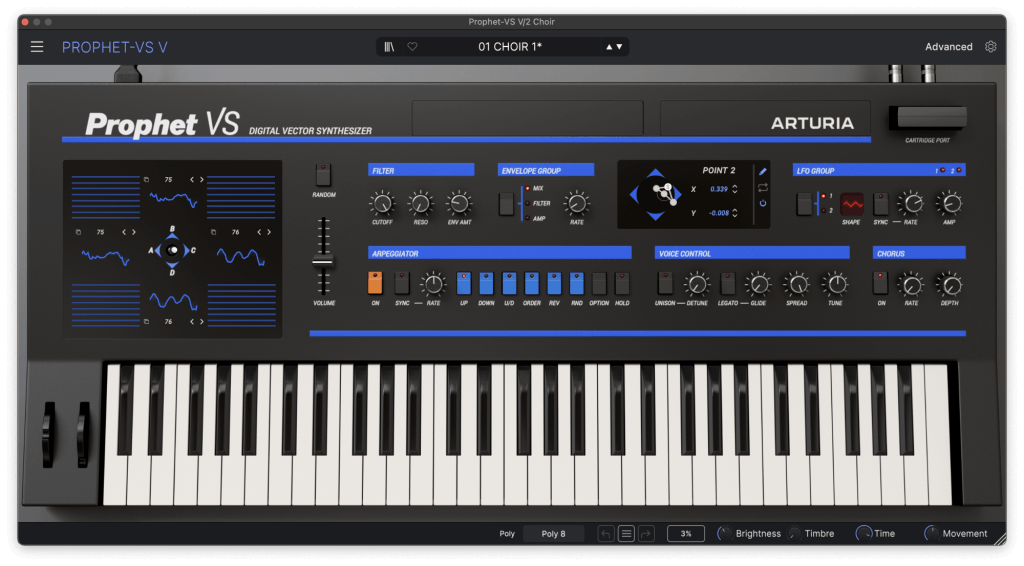
There’s a single-line choir sound in the background that adds a lot of atmosphere to the song. It simply plays high versions of the root notes of the underlying chords, so G | F♯ throughout.
For the synth sound I used a slightly modified version of the CHOIR 1 factory preset in Arturia Prophet VS. This isn’t exactly the same as what was used in the original song, but it got me in the ballpark. I added chorus to thicken it up slightly as well as lots of reverb to push it into the background.
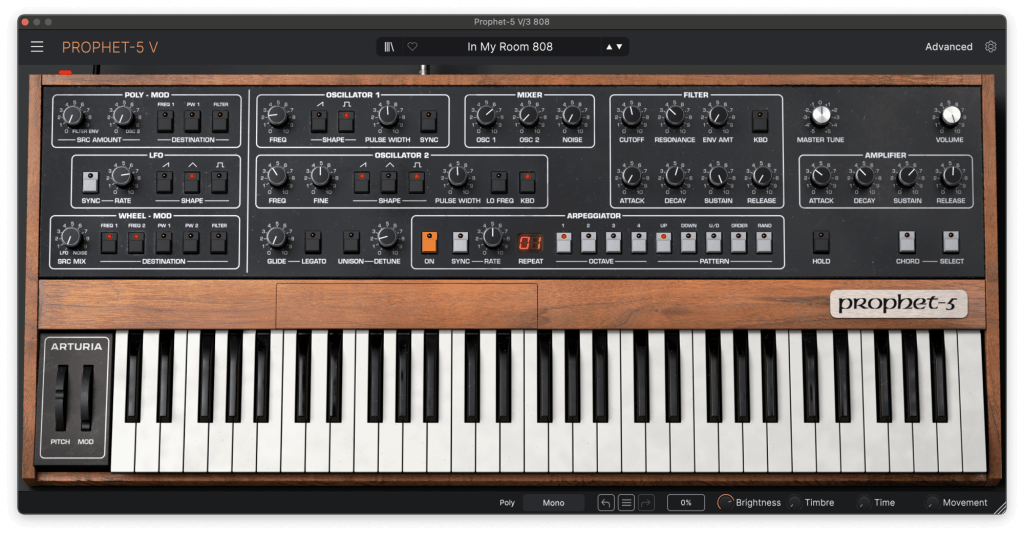
There’s also a deep 808 bass in In My Room. I programmed this patch myself in Arturia Prophet-5 V, though an 808 sample was probably used in the original song. In my case, it’s faster to recreate it than go through lots of 808 samples trying to match it.
My patch uses a square wave with a very low filter that removes everything apart from the very low end. The filter cutoff is set to 162 Hz, resonance is about 3.5, and there’s no keyboard tracking.
The 808 has a pitch glide that comes up from below rather than sliding down. I created this using the advanced section function generator in Prophet-5 V. It also has a soft amplifier envelope attack at 64 milliseconds, which creates a quick fade in that helps it get out of the way of the kick. I also used sidechain compression to further duck it when the kick hits.
The drums are split across three tracks. The first track handles the percussion elements: a laser sample that I edited the envelope and filter on in Sampler to get it closer to the original, a clap and side stick that hit 32nd notes apart the first time they play (which creates an almost slapback delay style effect), and a distorted conga.

The hi-hats are relatively typical trap-style programming with straight 16th notes for most of the song, but later on there are some 32nd note patterns that make things feel more frenetic.

The kick drum pattern is a four-bar loop, though it’s really more like a two-bar pattern with a variation in the fourth bar where there’s a nice 32nd note flourish at the end of the phrase. For this I used a kick sample from Splice’s Bedroom Beats & Lofi Hip-Hop pack with no extra processing.



Header artwork by Olya Makar
Article Comments